
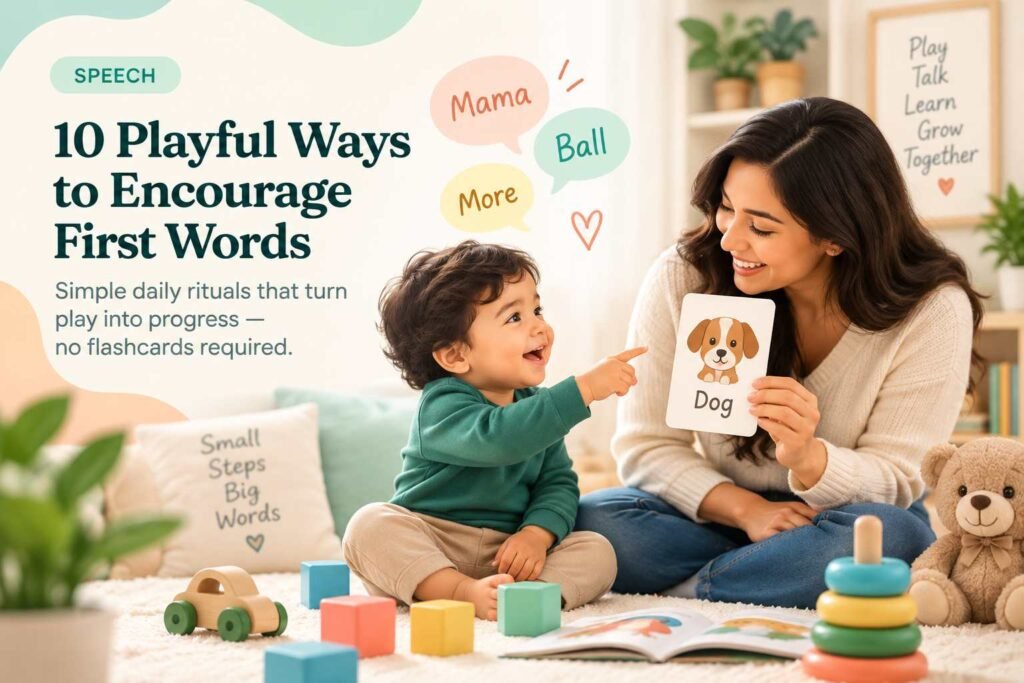
Simple daily rituals that turn play into progress — no flashcards required.
A child’s first words are exciting. “Mama,” “ball,” “more,” “bye-bye” — even a single new word can feel like a huge milestone.
But if your child is still finding their words, you may wonder: Am I doing enough? Should I be teaching them more?
The good news is that language development doesn’t have to look like a lesson. Some of the best opportunities for communication happen during ordinary moments — playing with toys, eating a snack, getting dressed, looking at books, or going for a walk.
Here are 10 simple, playful ways you can encourage communication at home.
1. Talk about what your child is already interested in
Follow your child’s lead.
If they’re playing with a car, talk about the car:
“Car!”
“Red car.”
“Car goes vroom!”
If they’re looking at a dog:
“Dog!”
“Big dog.”
“Dog says woof!”
You don’t need to constantly ask your child to repeat you. Simply hearing useful words connected to something they care about gives them meaningful opportunities to learn.
2. Use short, simple phrases
When your child is just beginning to communicate, keep your language easy to follow.
Instead of:
“Would you like me to give you your favourite blue ball?”
Try:
“Want ball?”
Or:
“Blue ball!”
As your child begins using words, you can gradually expand what they say.
If your child says: “Ball.”
You might respond: “Big ball!”
This gives your child a slightly richer version without turning the moment into a test.
3. Create little reasons to communicate
Sometimes children don’t need more questions — they need more opportunities.
Put a favourite toy just out of reach.
Pause before giving them a snack.
Give them a choice between two toys.
Then wait.
For example:
“Car or ball?”
Hold both up and give your child time to respond by looking, pointing, gesturing, making a sound, or using a word.
Communication isn’t only about spoken words. Gestures, eye gaze, sounds and pointing are all meaningful ways children communicate.
4. Make everyday routines language-rich
You don’t need special activities to practise communication.
Talk during everyday routines.
While getting dressed:
“Socks on.” “Shoes on.” “One shoe.” “Two shoes!”
During bath time: “Water!” “Splash!” “Wash hands.”
During meals: “More?” “Apple.” “Yummy!” “All done.”
These repeated routines help children hear the same useful words in meaningful situations.
5. Turn books into conversations
You don’t have to read every word on every page.
Look at the pictures together.
Point to a dog and say: “Dog!”
Then pause.
Your child might point, make a sound, or eventually say “dog.”
You can also ask simple questions:
“Where’s the cat?”
If your child doesn’t answer, that’s okay. You can simply point and say:
“There! Cat!”
Reading, talking about pictures and telling stories are all useful ways to support language development. (ASHA)
6. Sing songs with actions
Songs are wonderful because they naturally encourage repetition.
Try:
- Wheels on the Bus
- Head, Shoulders, Knees and Toes
- If You’re Happy and You Know It
- Twinkle, Twinkle, Little Star
Pause before an important word.
For example: “Twinkle, twinkle, little…”
Then wait.
Your child might eventually fill in: “Star!”
Actions make songs even more engaging and give children another way to participate.
7. Make silly sounds
Communication can be fun.
Make animal sounds: “Moo!” “Woof!” “Meow!”
Make vehicle sounds: “Vroom!” “Beep beep!”
Blow bubbles:
“Pop!”
These playful sounds can make it easier for children to join in without feeling like they’re being asked to “say a word.”
8. Give your child time to respond
One of the simplest things parents can do is wait.
After you say something or ask a question, give your child a few moments to respond.
It can feel surprisingly long at first.
Try not to immediately answer for them.
Give them the space to:
- Look
- Point
- Gesture
- Make a sound
- Attempt a word
- Use a word they already know
Every attempt is worth noticing.
9. Celebrate communication, not perfection
If your child says “Ba” for “ball”
you don’t necessarily need to correct them.
You can simply respond. “Yes! Ball!”
The goal is to show your child that their communication works.
Children develop speech and language at different rates, and individual milestones can vary. Developmental milestone lists are useful for guidance, but they’re not diagnostic tools. (ASHA)
10. Make talking part of play
Play gives children a reason to communicate.
Build a tower together: “Up, up, up!”
Then knock it down: “Crash!”
Feed a toy: “Eat!”
Put the toy to bed: “Night-night.”
Pretend to cook. “Hot!” “More?” “Yummy!”
The more enjoyable communication feels, the more opportunities your child has to practise.
When should you seek professional guidance?
If you’re concerned about your child’s speech or language development, you don’t need to wait until the concern becomes bigger.
A speech-language pathologist can look at your child’s communication skills and help you understand what may be supporting their development.
ASHA also recommends seeking professional guidance when parents have concerns rather than simply waiting. (ASHA)
Most importantly, remember this:
You don’t need to turn your home into a classroom.
Talk. Play. Read. Sing. Listen. Wait.
Those little moments throughout the day can create meaningful opportunities for your child to communicate.
Looking for support?
At Ovieel, you can connect with therapists who understand children’s communication and developmental needs.
Find a Therapist →
