
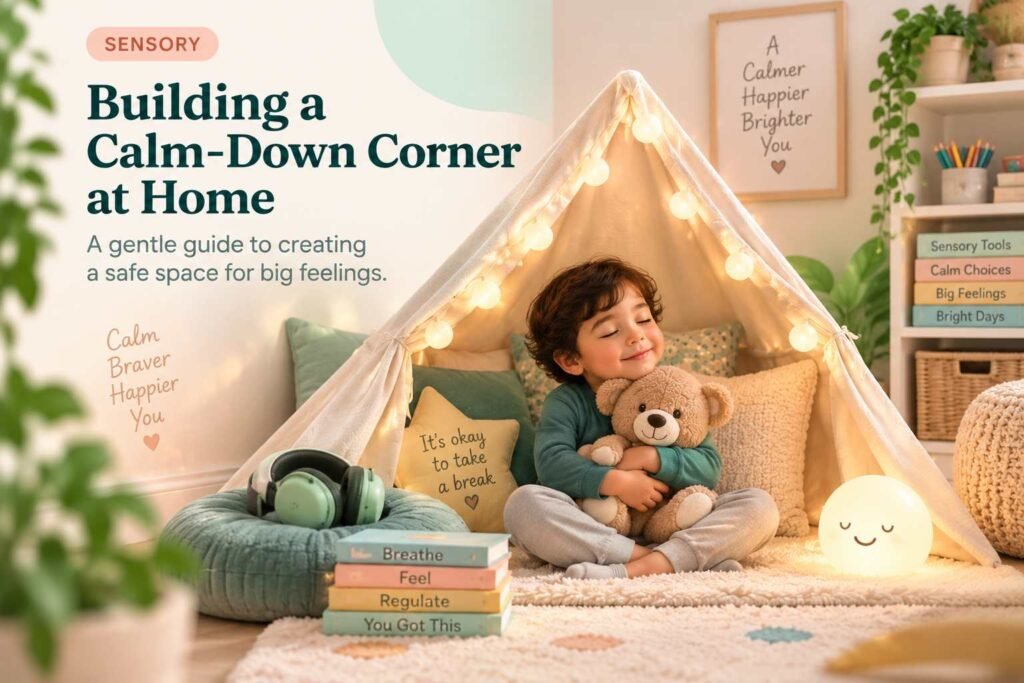
A gentle guide to creating a quiet space that helps your child feel safe, settled and ready to regulate.
Some days are simply too much.
The lights feel too bright. The house feels too noisy. A change in plans leads to tears. A busy day at school is followed by a difficult evening at home.
When children become overwhelmed, they may need more than a reminder to “calm down.”
They may need a place where their environment feels a little easier to manage.
That’s where a calm-down corner can help.
A calm-down corner is a small, comfortable space where your child can take a break from overwhelming stimulation and practise calming strategies. It shouldn’t be a punishment or a place where your child is sent when they’ve “misbehaved.”
Instead, think of it as a safe place to reset.
What makes a calm-down corner helpful?
A calm space can reduce some of the stimulation around a child when they’re feeling overwhelmed.
For some children, that may mean:
- Less noise
- Softer lighting
- Fewer people
- Comfortable textures
- Familiar objects
- A predictable place to take a break
Quiet spaces can be especially helpful for children who become overwhelmed by sensory input. (Raising Children Network)
And you don’t need a huge room.
A corner of a bedroom, living room or playroom can work beautifully.
1. Choose a quiet location
Look around your home.
Is there a corner that is naturally a little quieter?
It could be:
- A bedroom corner
- A reading nook
- A space beside a bookshelf
- A small play tent
- A corner of the living room
The goal isn’t complete silence.
It’s simply to create an area with fewer distractions.
2. Make it comfortable
Start with the basics.
You might add:
- A soft mat
- Cushions
- A blanket
- A favourite stuffed animal
- A small pillow
- A comfortable chair
Let your child help choose some of the items.
A safe-space activity can also be as simple as building a small fort using blankets and everyday household objects. Quiet, low-stimulation spaces can help children feel more in control of their environment. (Raising Children Network)
3. Think about lighting
Bright lights aren’t comfortable for every child.
If possible, experiment with:
- Natural light
- A small lamp
- Dimmer lighting
- Soft fairy lights
- Curtains that reduce glare
You don’t need to make the space completely dark.
Just observe what helps your child feel comfortable.
4. Add a few calming sensory tools
You don’t need to fill the corner with expensive sensory products.
Start with a few things your child already enjoys.
For example:
Touch:
A soft blanket, stress ball or playdough.
Sound:
Headphones or quiet music.
Visual:
A favourite book or simple picture cards.
Movement:
A cushion for stretching or gentle movement.
Some children benefit from sensory toys, music, playdough or other familiar calming activities. (Raising Children Network)
But remember:
More sensory input isn’t always better.
If your child is already overwhelmed, adding lots of sounds, lights and objects may make the space less calming.
Keep it simple.
5. Give your child choices
A calm-down corner works best when your child has some ownership of it.
You might ask:
“Would you like your blue blanket or your teddy?”
Or:
“Do you want music or quiet?”
Giving small choices can help children feel more in control.
For some children, even choosing where to sit can make a difference.
6. Practise using the space when your child is calm
This is important.
Don’t wait until your child is already overwhelmed to introduce the calm-down corner.
Visit it during peaceful moments.
Read a book there.
Cuddle a stuffed animal.
Listen to quiet music.
Practise slow breathing.
The idea is for your child to learn:
“This is my safe place.”
Then, when difficult feelings arrive, the space is already familiar.
Relaxation and breathing activities can become easier when children practise them regularly rather than only during stressful moments. (Raising Children Network)
7. Stay connected
A calm-down corner shouldn’t mean:
“Go away until you behave.”
Instead, you might say:
“I can see you’re having a hard time. Let’s take a break.”
For younger children especially, staying nearby and offering reassurance can help them calm down. This approach is sometimes called time-in — supporting the child while they experience strong emotions rather than isolating them. (Raising Children Network)
You can sit beside them.
You can breathe together.
You can simply be quiet.
You don’t always need to talk.
8. Teach one or two calming strategies
Keep it simple.
Try:
Smell the flower, blow the candle
Pretend to smell a flower while breathing in.
Then pretend to blow out a candle while breathing out.
Repeat a few times.
Squeeze and release
Squeeze a soft ball or pillow.
Hold for a few seconds.
Then release.
Five things I can see
Ask your child to look around and name things they can see.
These activities can be practised during calm moments so they become familiar when your child needs them. (Raising Children Network)
9. Let your child leave when they’re ready
The calm-down corner isn’t supposed to become a place where your child has to stay for a predetermined amount of time.
Some children may need two minutes.
Others may need fifteen.
Follow your child’s cues.
The goal is regulation, not compliance.
10. Remember that every child is different
A strategy that works beautifully for one child may not work for another.
One child may love a weighted-feeling cushion.
Another may dislike it.
One child may find music calming.
Another may need complete quiet.
One child may want company.
Another may need space.
Start small, observe your child and adjust.
A calm corner isn’t a cure-all
A calm-down space can be a useful tool, but it doesn’t replace professional support when a child is regularly struggling with sensory processing, emotional regulation, anxiety, communication or behaviour.
If your child’s reactions are frequent, intense or interfering with everyday life, consider speaking with an appropriate child-development professional.
And remember:
The goal isn’t to teach children never to feel overwhelmed.
It’s to help them learn that when big feelings arrive, they have safe ways to pause, reconnect and recover.
Need professional support for your child?
Ovieel connects families with verified therapists across speech therapy, occupational therapy, child psychology, behavioural therapy and other developmental services.
Find a Therapist →
